
The carbon brush blocks listed below are samples mailed by our customer, which require Shore HS hardness testing.
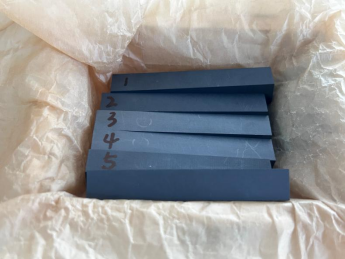
We adopt the Shore hardness tester shown above to conduct hardness testing on the customer’s samples.
This Shore hardness test for carbon blocks is a dynamic rebound hardness test. A diamond indenter with fixed mass falls freely from a standard height to impact the surface of the carbon block. The Shore hardness value (HS/HSD) is converted based on the elastic rebound height of the material. The hardness reading directly reflects the density, graphite orientation, pore structure and surface elastic deformation resistance of the carbon block.
Specimen Requirements for Testing
The carbon block shall have a minimum thickness of 5 mm. Thin sheets, tiny fragments and thin-walled carbon parts are not eligible for testing. Insufficient thickness will cause vibration and deformation of the specimen, resulting in abnormally high hardness readings. The tested surface must be flat, free of cracks, dust and loose chipping, with surface roughness Ra ≤ 3.2 μm. Rough and porous surfaces absorb impact energy, which leads to low measured hardness values.

Advantages of This Shore Hardness Tester
This portable Shore hardness tester is lightweight and easy to operate, requiring no matching test stand. Large carbon blocks, carbon bricks and formed blanks can be tested directly on-site without cutting samples. It is suitable for production line spot inspection and finished product on-site acceptance.

High-efficiency Non-destructive Testing
Readings are available within seconds, ideal for rapid mass testing. The impact indentation is extremely shallow without damaging the working surface of workpieces, leaving no adverse impact on subsequent machining and assembly after testing.
Precautions
It should be noted that this hardness tester has limitations in comparison with static hardness testing in terms of accuracy: test data is scattered with average precision. The test results are greatly affected by the verticality of the instrument, surface finish of carbon blocks, internal pores and graphite grain orientation. Multi-point test values on the same specimen fluctuate significantly. Hardness data is only comparable for carbon blocks with similar elastic modulus and pore structure. Test values of carbon blocks with different formulas or graphitization degrees cannot be directly referenced.
During testing, particles are directionally arranged during carbon block forming, leading to different rebound values parallel and perpendicular to the forming direction. A fixed sampling direction must be adopted during testing; otherwise, the test data will be invalid.
Post time: Jun-18-2026


